
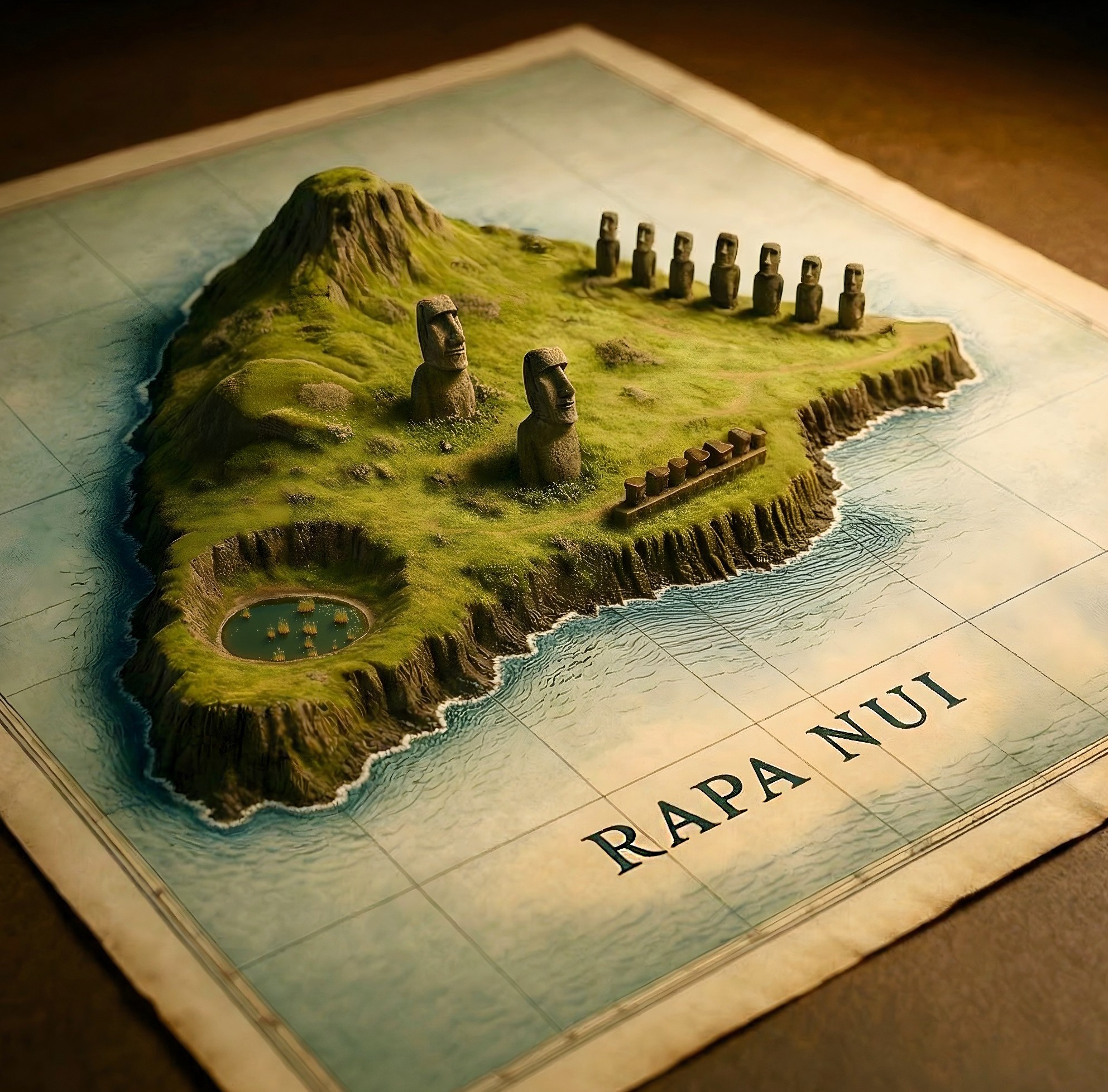
Our brand of natural cosmetics Anakena was born in one of the most remote places in the world: in Rapa Nui, Easter Island. In the middle of the South Pacific, thousands of miles from any continent, this island holds much more than its enigmatic moai statues - it also houses a language whose history is as extraordinary as the island itself. Where does the Rapa Nui language come from, why is it related to Māori and Hawaiian, what does it have to do with one of the great migrations in human history - and what mystery does it refuse to reveal to this day?
Where does the Rapa Nui language come from and who speaks it?
The Rapa Nui language belongs to the Eastern Polynesian subgroup of the Austronesian language family, one of the world's great linguistic trunks. It may sound dry - but it's not at all dry: this family includes around 1,200 languages which extend from Taiwan, through the Philippines, Indonesia and Madagascar, to the farthest corners of the Pacific. The Rapa Nui language occupies the eastern end of this linguistic space: morphologically closer to the Marquesan languages, and surprisingly similar in sonority to the Māori of New Zealand.
About 8,000 people live on the island today - but what followed the first colonization was nearly a total loss. In the 1860s, Peruvian slave traders raided Rapa Nui and took more than a thousand people, including the king, his son and virtually the entire religious elite. Of the deportees, 90% died. When the few survivors were returned, a smallpox epidemic that they brought with them almost wiped out the rest of the population: by 1871, only 230 people remained on the island. With annexation by Chile in 1888 came another blow - Spanish became the language of school and administration, and the transmission of the Rapa Nui language broke down generation after generation. A 2016 study revealed that in the 8-12 age group, only 16.7 percent were proficient in the language.
Since then, awareness of this loss has grown - and with it the will to recover it. Today there is school education in Rapa Nui, specific teaching materials are being developed, and the community of speakers is estimated at between 2,500 and 3,500 people worldwide, spread across the island, the Chilean mainland and the Polynesian diaspora.
A language that spans the Pacific - and why it is so.
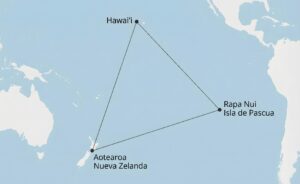
To understand why the Rapa Nui language, Māori and Hawaiian are related to each other, you have to go back some 4,000 years. The starting point is in Taiwan. From there, the ancestors of the future Polynesians - known today under the term Lapita culture - they undertook one of the greatest migrations in the history of mankind. Not by land, but on the open sea: in double-hulled boats that could reach thirty meters in length and carry several hundred people.
For millennia they advanced eastward: from Taiwan through the Philippines and Melanesia, then to Samoa and Tonga, from there to the Marquesas and finally in all directions of the Pacific - northward to Hawai'i (around 400 A.D.), westward to New Zealand (around 1000 A.D.) and eastward to Rapa Nui (around 300 A.D.). The result is the so-called Polynesian Triangle: a linguistic space that extends over more than 16 million square kilometers ocean - with Hawai'i to the north, Rapa Nui to the east and New Zealand to the southwest as apexes.
To put it in perspective: the distance between Rapa Nui and Hawai'i is about 7,500 kilometers - almost twice as far as from Madrid to Moscow. And the total area of all the Polynesian islands, excluding New Zealand, is roughly the size of Belgium. Tiny specks of land scattered in an endless ocean. United not by bridges or roads, but by the tradition of a seafaring culture that navigated without a compass or modern instruments, guided by the stars, wind and cloud patterns, the swell of the sea and the behavior of birds - because certain species, such as terns, only cross open water when land is near.
Precisely because all these islands were colonized by the same ancestors in a relatively short period of time, the language remained recognizably related - even thousands of miles away.
Moana, Rā, Tangata - what languages still share today.
| Meaning | Rapa Nui | Māori | Hawaiian |
|---|---|---|---|
| Sol | rā / raꞌa | rā | lā |
| Sea / Ocean | moana | moana | moana |
| Person | tangata | tangata | kanaka |
| Earth | enua | whenua | ʻāina |
What rā to become lā in Hawaiian is not an error - but a regular phonetic change that linguists can trace back to Proto-Polynesian. The same is true of the passage of t a kthe word tangata (person, and in māori also verb meaning «to be a person») corresponds to Hawaiian kanaka - same root, different phonetic path. These shifts were not arbitrary, but followed clear linguistic laws that can be reconstructed for each language group.
The scarcity of sounds in the Polynesian languages is also striking. Hawaiian has only 13 distinct phonemes - which places it among the languages with the fewest sounds in the world. Clear vowels, few consonants, syllables that follow the simple consonant-vowel pattern: that makes Polynesian languages extraordinarily regular. Does it have something to do with the demands of long journeys - with the need to transmit the language orally over generations and great distances? It is a thought-provoking question.
Rongo Rongo - the unsolved enigma of the island
Rapa Nui possesses something that no other Polynesian island has: its own writing. The Rongo Rongo glyphs - engraved on wooden tablets, made known to the outside world in the 19th century - have not been deciphered until today. Hundreds of signs representing people, birds, fish and abstract forms, in a system that has fascinated linguists and archaeologists alike for more than 150 years.
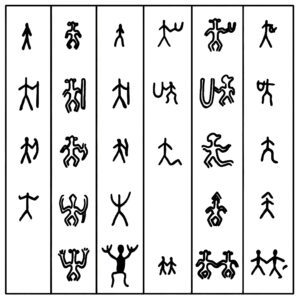
Rongo Rongo glyphs from: Jean-Michel Schwartz, «The Secrets of Easter Island» (1975), graphically edited. Undeciphered to this day.
When and how Rongo Rongo came about is an unanswered question. One widely held theory holds that it was the Spanish expedition under Felipe Gonzalez de Ahedo in 1770 that provided the impetus: the navigators arrived on behalf of the Spanish Crown to take formal possession of the island - and brought with them the concept of writing. At the ceremony, the Rapa Nui chiefs signed an act of annexation, supposedly in Rongo Rongo signs. However, new radiocarbon dating of some tablets suggests that writing may have existed even before that contact. If so, the Rongo Rongo would be one of the few independent inventions of writing in history - a phenomenon that, according to records, has occurred only a handful of times worldwide.
Why it is so difficult to decipher it has a concrete reason: the knowledge of the priests who used the Rongo Rongo disappeared almost completely with the Peruvian slave raids of the 1860s. All the preserved ancient tablets are today in museums outside the island. The Rongo Rongo remains one of the great enigmas of Pacific research - and a silent witness to what disappeared forever with those priests.
Theories on the colonization of Easter Island
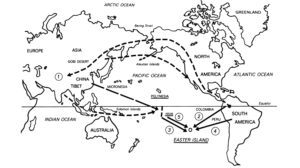
Map from: Jean-Michel Schwartz, «The Secrets of Easter Island» (1975), graphically edited.
The map reflects the state of 20th century research - some of the theories represented are now considered superseded.
The arrows show different theories about how Rapa Nui was colonized. ① Origin of Austronesian peoples in Asia. ② Links to the South American coast - partially supported by genetic analysis. ③ Colonization from the west through Polynesia. ④ Colonization from the west coast of South America - now largely refuted. ⑤ Arrival from the Marquesas Islands (Hiva) - the most scientifically supported theory.
Rapa Nui and Anakena - Natural Cosmetics
Rapa Nui is much more than a solitary dot on the map. The island is home to a language that emerged from one of the boldest migrations in human history - and that, despite it all, is still alive. Its kinship with Māori, Hawaiian and other Polynesian languages is not a linguistic fluke, but the echo of millennia-long journeys across the world's largest ocean.
Rapa Nui is the birthplace of our brand - and that's no small detail. An island of extraordinary history and cultural depth. A language that for a time was spoken by only a few and that today is preserved and promoted with determination. A people of unique culture who colonized vast stretches of the Pacific without maps or compasses. We look at this history with respect and, at the same time, with pride. Both sentiments deeply permeate everything we do at Anakena - Natural Cosmetics.
This article was published on the occasion of International Mother Language Day - known on Rapa Nui as He Mahana o te Re'o Tumu Matu'a - celebrated every February 21 around the world.
Disclaimer: This article is based on self-study of publicly available scientific sources and is not a substitute for expert advice. We have endeavored to research all data rigorously, but cannot guarantee its completeness or absolute accuracy.


 Español
  English