
The Sacred Beach Where History Meets Legend
Anakena Beach, with its white coral sand and turquoise waters, is not only the most beautiful beach in the Easter Island, but also its most sacred site. This is where legend and archaeology converge, where King Hotu Matu’a and the first Polynesian settlers are believed to have landed more than 1,500 years ago, laying the foundations of the Rapa Nui civilization.
Today, two magnificent ahu (ceremonial stone platforms) stand in Anakena, with their moai facing inland as they have done for centuries, silent guardians of this ancestral cradle. These are not just archaeological monuments—they are living connections to the spiritual heritage of the island and the birthplace of the culture that inspired our brand Anakena – Natural Cosmetics.
Ahu Nau Nau: The Seven Guardians
The Best-Preserved Moai on the Island
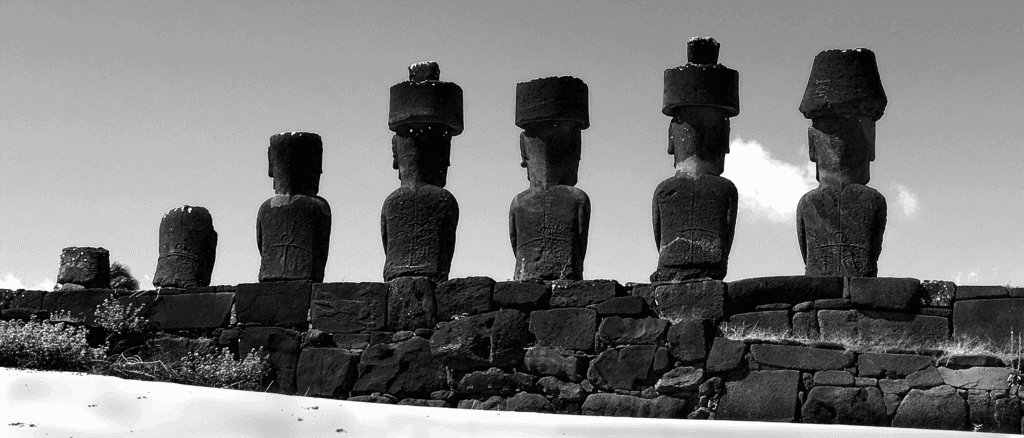
Dominating the center of Anakena Beach is Ahu Nau Nau, an impressive 70-meter-long platform with seven beautifully restored moai. What makes these statues truly exceptional is their remarkable state of preservation—they spent hundreds of years buried under the sand, protected from wind, rain, and sun, allowing their intricate carvings to remain clearly visible today.
The restoration was carried out by Sergio Rapu's team between 1978 and 1980, revealing moai with finely carved details on their backs and bodies that have worn away on most of the other statues on the island. One interpretation is that these moai represent deceased young people of royal lineage, their eyes looking across the bay where their ancestors arrived.
The Name and Its Meaning
The name “Nau Nau” is believed to be associated with the naunau or nau opata, an extinct shrub from the sandalwood family whose aromatic wood was used to make perfume and produced nutritious nuts. According to legend, King Hotu Matu'a and his followers brought these nuts from their homeland to sustain themselves during their first months on the island.
The Pukao: Headgear of Power
Four of the seven moai wear distinctive reddish pukao (buns or headdresses) on their heads, carved from red scoria stone quarried from the Puna Pau crater. These cylindrical headdresses, some weighing several tons, were added during later phases of construction and may represent hair tied in a bun or special headdresses symbolizing high rank and mana (spiritual power).
Discovery of the Eyes of the Moai
During the 1978 excavation at Ahu Nau Nau, archaeologists discovered 57 fragments of moai eyes made of white coral, many still bearing marks from the tools used to carve them. This groundbreaking discovery proved that the moai once had eyes, transforming our understanding of these monuments. Four fragments that form an almost complete eye are currently on display at the Padre Sebastián Englert Anthropological Museum on Easter Island.
These coral eyes with obsidian or red slag pupils would have given the moai an intense and lively gaze, reinforcing their role as conduits between the living and the ancestral world.
Ahu Ature Huki: The First Moai Re-erected
A Historic Milestone in Modern Restoration
To the right of Ahu Nau Nau, at the foot of Mount Maunga Hau Epa, stands Ahu Ature Huki with its solitary moai—the first statue to be re-erected in modern times. Although less visited than its neighbor, this weathered figure is of immense historical importance.
In 1956, Norwegian explorer Thor Heyerdahl and his team, working with 12 local men, successfully raised this 3-meter, nearly 30-ton moai using traditional methods. Heyerdahl documented the process in his famous book “Aku Aku,” describing how Mayor Pedro Atan recruited workers who used large rocks, three long wooden poles, and ropes to gradually lift the statue over 18 days.
This successful experiment proved that the ancient Rapanui people could have erected these massive statues without modern technology, using only wood, stone, rope, and human ingenuity. It marked the beginning of modern restoration efforts on Easter Island and inspired subsequent projects across the island.
Cultural and Spiritual Significance of the Ahu
More than Stone Platforms
The ahu are the ceremonial heart of Rapa Nui culture—sacred spaces that served as burial sites, places of worship, and focal points for community gatherings. The ahu moai platforms were built to display giant statues representing ancestors, who were believed to bestow mana (spiritual power and protection) upon the living community.
The moai do not face the ocean—they face inland, watching over the villages and farmlands of their descendants. This orientation emphasizes their role as protectors and intermediaries between the mortal and spiritual realms.
Astronomical Alignments
Many ahu, including those at Anakena, were carefully oriented according to astronomical phenomena. Coastal astronomical ahu are preferably oriented in an equinoctial, north-south direction, so that the moai face directly east or west. This suggests that the platforms served not only religious and social functions, but also helped to mark important agricultural and ceremonial seasons.
Archeological Evidence of Ancient Settlement
Anakena is more than just a legendary landing site—it is archaeologically confirmed as one of the oldest inhabited areas on the island. Evidence suggests that the first settlement at Anakena may be 200 to 300 years older than the initial construction of the ahu, supporting the connection between legend and historical reality.
Excavations have revealed multiple layers of older ahu platforms beneath the visible structures, remains of ancient dwellings including paenga house foundations (boat-shaped structures), earth ovens (umu pae) used for cooking, and evidence of fenced gardens (manavai) for cultivation.
Near Ahu Nau Nau, archaeologists identified the foundation stones of what tradition identifies as the house of Hotu Matu’a—an exceptionally large structure, oriented north-south. Its presence reinforces Anakena’s status as the island’s founding settlement.
The Territory of the Miru Clan
Anakena belonged to the territory of the powerful and influential Miru clan, which provided the Ariki Mau (the supreme chief and spiritual leader of the island) and traced its lineage directly back to Hotu Matu’a. This royal connection made Anakena one of the most important ceremonial and political centers during the island's classical period.
The concentration of elaborate ahu and finely carved moai at this site reflects the prestige and resources commanded by the Miru lineage.
Visiting Anakena Today
Today, Anakena Beach offers visitors a unique combination of natural beauty and deep cultural significance. The white coral sand (one of only two beaches on the predominantly rocky island), palm trees (introduced from Tahiti in the 20th century), and turquoise waters create a stunning backdrop for the ancient ahu and moai.
Location: 18 kilometers from Hanga Roa on the north coast of the island. Accessible by paved road by car, taxi, bicycle, or guided tour.
Facilities: Parking, restrooms, shaded areas, food kiosks serving local dishes, and craft vendors.
Cultural Respect
When visiting these sacred sites, observe the moai from designated areas and do not touch the statues. Remember that these are not merely tourist attractions but sacred sites for the Rapa Nui people. Every July 7, the Rapa Nui community commemorates the arrival of Hotu Matu’a with traditional ceremonies, songs, dances, and offerings at Anakena.
The Anakena Connection
This sacred beach—where the first settlers landed, where royal lineages established their power, where magnificent moai stand guard—is the namesake and inspiration for our brand Anakena – Natural Cosmetics. Just as this place represents the beginning of the Rapa Nui civilization, our products are based on the pure and natural traditions of Polynesia, connecting modern beauty care with ancestral wisdom.
The name “Anakena” embodies the essence of this special place: natural beauty, cultural depth, and the meeting point between legend and reality. When you use Anakena products, you are connecting with the same spirit that has made this beach sacred for more than fifteen centuries.
Discover more about the cultural heritage that inspires our brand by exploring our other articles on Easter Island, Polynesian traditions, and the natural ingredients that define Anakena – Natural Cosmetics.